Afterworld Dev Diary 2: The Afterworld
Dan Lind's second diary on society types, the Turns Expedition, and the literary influences that shaped this world.
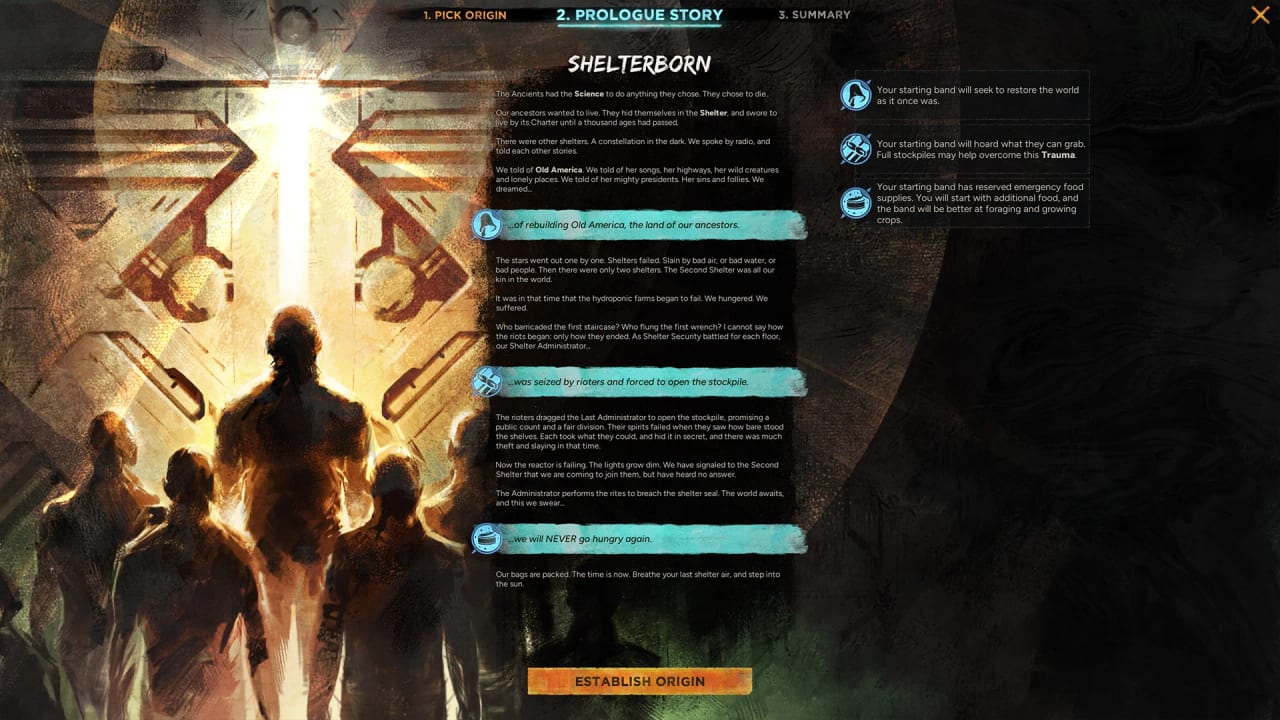
Dev Diary 2 dropped on 16 September 2026, roughly three weeks after the opening announcement. Where Diary 1 established the core framing — GSG plus settlement survival, a century after The Fall — this second entry digs into the world itself: the societies your tribe will meet, the turns-based expedition system called the Turns Expedition, and the literary and cultural influences the team drew from when building Afterworld’s civilizations. Read this alongside the Dev Diary 1 summary for the full design vision, and the gameplay deep dive for what the alpha B-roll actually shows on screen.
Society types: Band, Settlement, and what comes next
The diary introduces three formal society scales. A Band is your starting unit — a small, mobile group held together by shared trauma and improvisation. Bands can scout, raid, and relocate, but they lack the infrastructure to support large populations or complex laws. The diary frames the band as a narrative unit first: you know every character, and every crisis is personal.
A Settlement is what happens when a band puts down roots. Settlements have fixed positions on the map, food and water infrastructure, and the ability to accumulate surplus. This is where the settlement-survival layer activates in full: law drafting, official appointments, and the political tensions between what the settlement needs and what individual characters want. The diary notes that settlements are not automatically stable — a food shortage or a poorly chosen law can fracture one.
The diary hints at a third scale — something larger than a settlement, likely a city-state or regional power — but stops short of naming it. The settlements guide covers what is confirmed; this page will update the moment a diary names the larger tier.
The Turns Expedition
One Proud Bavarian, who visited the Stockholm studio in August, reported a follow-up interview scheduled for 1 September. The Turns Expedition system described in that interview is the game’s internal calendar and expedition framework. Think of it as a dual-layer clock: the Turn is the strategic pulse — seasons or years that drive resource regeneration, migration cycles, and the rhythm of lawmaking. The Expedition is the narrative skin: each expedition is a discrete journey with a beginning, a cast, and an outcome that shapes your society’s memory.
The diary gives a concrete example: a shepherd in the Santa Monica Mountains, recorded during the Turns Expedition research phase. Grass that summer was taller than last year’s; a ewe was lost in the hills. That small entry is the kind of material the team collected to ground the procedural generation in real texture. The expedition system generates these entries from your actual campaign events, giving each run a documentary quality.
The map guide will be updated when the diary names map modes or hex mechanics. Until then, the Turns Expedition is the frame through which the map’s fog and scouting system delivers stories rather than just coordinates.
What inspired Afterworld’s societies
The diary names several inspirations explicitly. Mad Max and A Canticle for Leibowitz are the obvious ones — post-apocalyptic settings where different groups preserve, distort, or weaponize the remnants of an advanced civilization. Rimworld is named as a design touchstone for how narrative emerges from systems interacting.
More surprising are The Epic of Gilgamesh, the SCP Foundation, and King of Dragon Pass. The Gilgamesh reference appears in how the game handles legacy — your decisions echo through generations, and the game tracks the long-term memory of your nation the way an epic tracks a bloodline. The SCP Foundation influence shows in how the game presents anomalous discoveries: remnant tech, ancient sites, and pre-Fall artifacts are documented with clinical detachment, letting the player supply the horror or wonder. King of Dragon Pass, the 1996 strategy game, is credited with the idea that a society’s culture can be a mechanical resource — that the stories your people tell about themselves shape what they are capable of.
These influences are not cosmetic. The diary implies that the Ideas Tree and the law-drafting system are direct mechanical descendants of King of Dragon Pass’s culture mechanics. If you have not played King of Dragon Pass, the origins page and the Ideas Tree page both benefit from knowing why the team reached for it.
The Afterworld itself — what the title means
The diary’s most evocative passage explains the title. The world is called the Afterworld not because it is a afterlife, but because it occupies the space after a civilization ends — the period where something new must be built from wreckage, and where the people doing the building are haunted by what came before. The Ancients are the ones who refused to let that haunting stop them; your tribe is the one that must decide what to do with the world they left behind.
That framing —废墟上的政治 (politics on rubble) — is the heart of the design. The game is not about rebuilding the old world. It is about deciding, as a society, what comes after.
How this diary updates the wiki
Diary 2 confirms the three-scale society model (Band / Settlement / something larger). The settlements guide and the bands guide both need this framework. The Turns Expedition entry means the map guide has a named clock system to describe. The inspiration list upgrades the preview and any page that claims Afterworld is “just Fallout meets CK3” — it is considerably stranger and more literary than that.
This wiki will update each systems page as diary three approaches. The updates hub is where all official drops are logged. The roadmap remains the authority on what Paradox has confirmed for alpha, beta, and release.
What is still missing
No buildings are named. No unit roster exists. No third society tier is confirmed. No multiplayer details beyond the co-op-and-competitive promise. The diary ends with a reference to the next entry in two weeks — meaning diary three was expected around 30 September. Until that lands, treat every mechanical detail as announced but unconfirmed.
Frequently Asked Questions
Quick answers about Afterworld before launch.
What does Dev Diary 2 cover?
Three society scales (Band, Settlement, and a larger tier), the Turns Expedition calendar system, and the literary influences behind Afterworld's design.
What is the Turns Expedition?
The game's dual-layer time system: Turns drive strategic rhythm (seasons, migration cycles), while Expeditions are narrative events generated from your campaign's actual events — giving each playthrough a documentary quality.
What games inspired Afterworld?
Mad Max, A Canticle for Leibowitz, Rimworld, The Epic of Gilgamesh, the SCP Foundation, and King of Dragon Pass. King of Dragon Pass is credited with inspiring the culture-as-mechanical-resource idea.
When is Dev Diary 3 expected?
Diary 2 mentioned the next entry in two weeks, suggesting around 30 September 2026. Check the updates hub for the official link when it publishes.