Food, Water, Fuel, and the Afterworld Convoy Economy
You cannot rule a wasteland you cannot supply. Afterworld makes the convoy the second city.
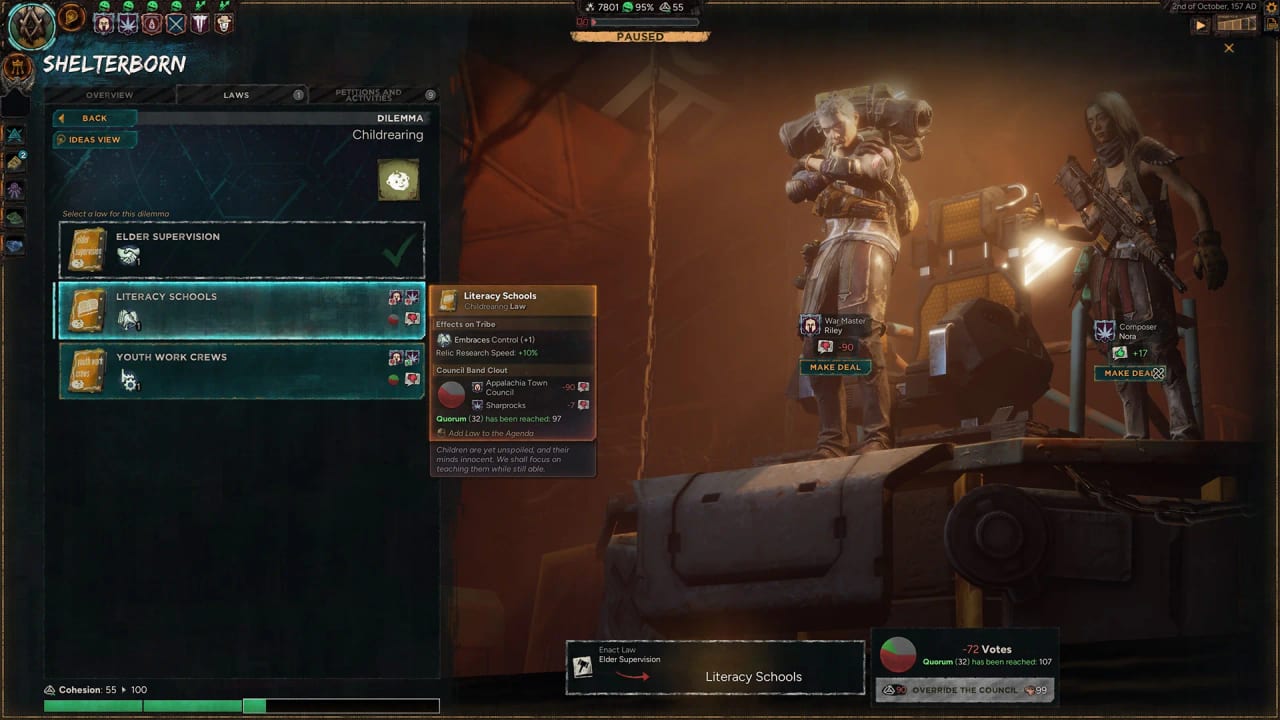
The economy in Afterworld is, at its core, the logistics of staying alive. The official Paradox store copy puts it bluntly: “scraping together food, water, and fuel in an environment that wants you dead.” The alpha B-roll, the IGN preview, and the Eurogamer preview confirm three visible resource families: food and water (basic survival), fuel (the truck economy), and what Eurogamer calls “salvage from the old world” (scavenge rolls, ruins, and the pre-Fall bunkers). Ammo and tools are visible in settlement screenshots but not yet enumerated in a Paradox diary.
Read this alongside getting started (start-to-survive basics), the map guide (what the regions yield), and combat (the ammo side). For trade and diplomacy over resources, see multiplayer once 1.0 releases.
The five-ish resources that show up in screenshots
The alpha B-roll and store screenshots show five-or-so visible resources on the settlement card:
- Food. Comes from agriculture (camp crops, irrigated fields), hunting (squirrels, deer, mutated fauna), and the gifting from caravans. Food deficit shows up as a red bar on the settlement card and as population maluses in the council.
- Water. Comes from clean wells, river access, and the late-game “purification” tech lane. Drought is a scripted crisis that the alpha trailer plays out (the dust-storm pulse that hits your main camp).
- Fuel. Powers trucks and generator-heavy buildings. The alpha B-roll shows a fuel gauge near the convoy UI. Fuel is the most convoy-dependent resource in the game because producing it at scale requires refineries that take many turns to build.
- Salvage / scrap. Eurogamer’s preview calls it “salvage from the old world.” It comes from scavenging parties that hit ruins and the pre-Fall bunkers surfaced in the origins guide. Salvage builds trucks, buildings, and the late-game Ancients tech.
- Ammo. Visible in the combat B-roll but not yet enumerated. Expect it to behave like fuel — produced by industry, consumed by raids, and limited in early game.
The wiki treats these five as canonical and awaits a Paradox diary that finalizes the per-resource yield tables.
How the convoy economy actually works
The convoy UI in the alpha B-roll shows a hub-and-spoke map with a truck icon between two settlement dots. Each segment is a route with a yield, a risk, and a “scavenge” button. The basic loop is:
- Build trucks. Salvage + population assigned to the vehicle workshops.
- Assign routes. Each route picks two endpoints and a resource target (food, water, fuel, salvage).
- Pay upkeep. Trucks consume fuel and risk convoy attacks from raiders or bandits.
- Defend or escort. Escorts can be added — the multiplayer video preview shows three-truck convoys with light escort.
- Profit. The endpoint receiving the convoy gets a yield boost and possibly a population bonus if the convoy delivers food.
This is the most gamey part of Afterworld. Crusader Kings has trade routes. Old World has cargo. Afterworld has the wasteland truck economy, and that is the difference: the truck is a unit that needs defending, and the convoy is a line that can be cut. Cutting a player’s fuel line is the canonical way to starve their war machine.
Salvage runs and the Ancients payoff
Salvage runs are how the late-game payoff works. The ancient tyrants guide explains that the Ancients’ pre-Fall tech can only be reactivated by someone willing to use it, and that someone has to physically dig it out of a ruin. Salvage runs are the act of digging. The “salvage from the old world” framing is also the game’s narrative justification for the Ancients arc — the same salvage run that brings you aluminum brings you something older.
Mechanically, that means every salvage run is a risk/reward roll. Low-risk ruins give you scrap and small amounts of late-game components. High-risk ruins (pre-Fall labs, military command bunkers) give you Ancients components that unlock the most powerful ideas in the ideas tree. The wiki will publish a ruin-tier table when Paradox publishes one. Until then, the safest rule of thumb is: closer to home = safer and lower yield, farther and older = riskier and higher yield.
Food, water, and the population cap
Food and water together drive the population cap. The settlement card shows a little house icon next to a number, and the number is the cap. If your food plus water minus your consumption goes negative, the cap drops. If the cap drops below your current population, you will start losing citizens to starvation, dehydration, or migration. Migration is the worse outcome because migrating citizens become a raider party that returns to fight you.
This is the survival pressure the official copy promises. It is not roleplay — it is a hard cap with three failure states: starve, dehydrate, migrate-and-fight. New players should treat their first ten turns as a food-and-water crisis, not a building project.
The five-step economy checklist
Every campaign should follow the same economic start:
- Secure water. Find a clean river or build a well. Without water, the settlement cap is two families.
- Build farms. Camp crops + irrigated fields are the cheapest food source. Pair with hunting for redundancy.
- Set up a salvage route. One short salvage route to the nearest ruin. The yield is small but it starts the convoy economy early.
- Train a convoy escort. A single light escort will deter raiders for the early game. The multiplayer preview shows three-truck convoys with escorts, which is the late-game default.
- Build a fuel reserve. Fuel is the most convoy-dependent resource. A single fuel reserve (a tanker truck parked at a refinery) will carry you through the first crisis.
Once the first crisis is past, expand into salvage, then industry, then Ancients tech.
What this page will add once more diaries land
Diary two was scheduled for Tuesday 1 September 2026 as a world diary; it had not surfaced as of 2 September 2026. When it does, expect:
- A per-resource yield table for each settlement tier.
- Convoy risk formulas and the bandit-spawn rate.
- Trade mechanics for the late-game diplomacy layer.
- The full list of resources (likely to include tools, medicine, and contraband alongside the five above).
Until then, treat the wiki’s five-resource list (food, water, fuel, salvage, ammo) as the canonical core and assume everything else is scaffolding until Paradox names it. For systems that move resources, see the map guide (regions yield), the combat guide (ammo use), and the updates hub for the diary that will finalize these tables.
Frequently Asked Questions
Quick answers about Afterworld before launch.
How many resources does Afterworld have?
The alpha B-roll shows at least five visible resources: food, water, fuel, salvage/scrap, and ammo. The wiki treats this list as the canonical core until Paradox publishes a full per-resource yield table.
Do I need trucks to play Afterworld?
Yes for any mid- to late-game campaign. The official copy treats the convoy as the second city. Early game you can survive on local food and water alone, but without trucks you cannot expand. See the map guide for region yields.
Can enemies cut my fuel line?
Yes. Convoy routes are interruptible and raids on convoys are scripted. The multiplayer preview shows convoy escort composition, which is the canonical defense. See multiplayer.
When will we get a real yield table?
Diary two was scheduled for Tuesday 1 September 2026 as a world diary and had not surfaced as of 2 September 2026. When it does, the updates hub will link to the new table.